Radon, an invisible, odorless radioactive gas, is a significant, yet often underestimated, environmental challenge for commercial properties. While commonly associated with residential homes, radon in commercial buildings is a pervasive issue that can impact indoor air quality, pose health risks to occupants, and create unexpected hurdles for development projects. Understanding its prevalence, regulatory landscape, and distinct mitigation approaches is crucial for property owners, developers, and general contractors looking to advance their projects confidently and create safer spaces.
The Unseen Challenge: Why Radon is Prevalent in Commercial Structures
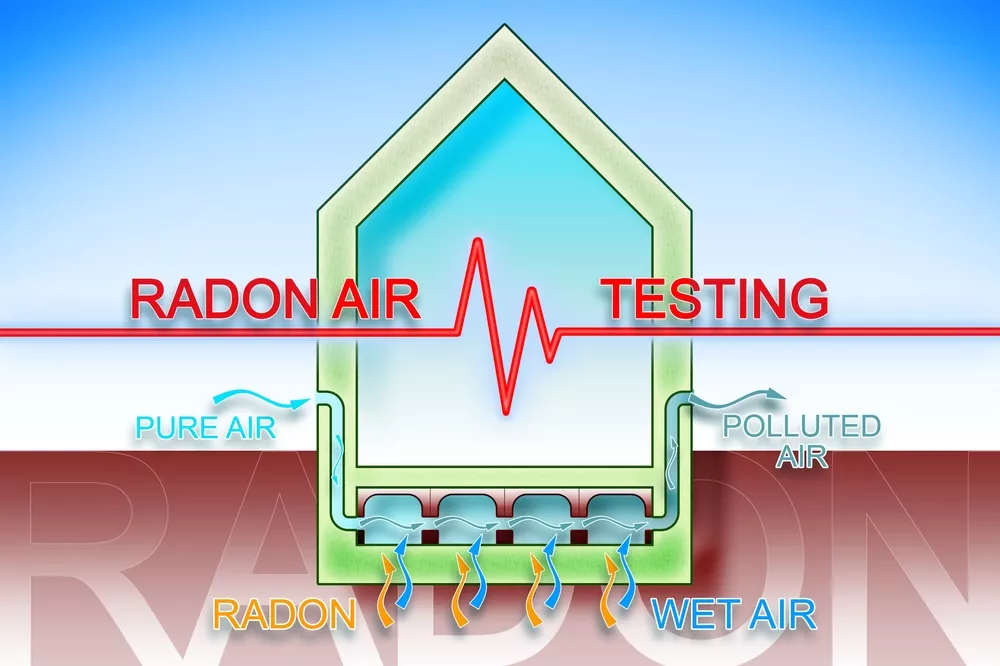
Radon originates from the natural breakdown of uranium in soil and rock. It can permeate building foundations through cracks, utility penetrations, and even porous concrete. Commercial buildings, with their larger footprints, extensive foundation systems, and often varying construction materials, present numerous pathways for radon entry. Unlike residential properties, commercial structures often have complex HVAC systems that can inadvertently draw radon indoors if not properly balanced or designed with radon entry in mind.
The perception that radon is primarily a residential concern often leads to overlooked testing and mitigation in commercial settings. However, any building in contact with the ground is susceptible. This includes office complexes, retail centers, schools, healthcare facilities, and multi-family residential buildings. Geographic location plays a significant role, with certain regions having naturally higher soil radon concentrations, making comprehensive testing a non-negotiable step for any new or existing development.
Identifying Radon Hotspots: Testing and Assessment
Effective management of radon begins with accurate testing. For commercial properties, this often involves a more complex assessment than typical residential testing. Longer-term tests (90 days or more) are generally preferred for commercial spaces to account for fluctuations in building operation, occupancy, and seasonal variations. Professional assessment considers:
- Building Size and Layout: Larger buildings require more test locations to ensure representative sampling.
- HVAC Systems: Understanding air pressure differentials created by ventilation systems is critical.
- Occupancy Patterns: How and when spaces are used can influence radon levels.
- Foundation Type: Slab-on-grade, crawl spaces, and basements each present unique entry dynamics.
Accurate testing provides the foundational data needed to develop a strategic pathway forward, transforming a potential obstacle into a manageable milestone.
Regulatory Landscape and Health Implications
The health risks associated with prolonged radon exposure are well-documented. It is the second leading cause of lung cancer overall and the leading cause among non-smokers. For commercial properties, this translates to significant liability concerns for property owners and managers, as well as a direct impact on the well-being of employees, customers, and tenants.
While there isn’t a national “radon code” for commercial buildings akin to some residential mandates, an evolving framework of guidance and standards exists:
- EPA Guidance: The U.S. Environmental Protection Agency (EPA) recommends mitigation for buildings with radon levels at or above 4 pCi/L (picocuries per liter). While not a federal regulation for commercial buildings, it serves as a widely accepted benchmark.
- ANSI/AARST Standards: The American National Standards Institute (ANSI) and the American Association of Radon Scientists and Technologists (AARST) publish comprehensive standards for radon testing and mitigation in both new and existing commercial buildings (e.g., ANSI/AARST CC-1000 for existing commercial/multi-family, RMS-MF for new construction). These provide industry best practices and often form the basis for state and local requirements.
- State and Local Codes: An increasing number of states and municipalities are incorporating radon-resistant construction techniques into building codes, particularly for new multi-family residences and schools. Property developers must navigate these diverse local requirements, which can vary significantly from one jurisdiction to another.
Ignoring these guidelines and potential risks can lead to project delays, increased costs, and reputational damage. Proactive engagement with radon challenges enables a smoother path to project completion and long-term asset value.
Commercial vs. Residential Mitigation: Distinct Approaches
While the core principle of radon mitigation—reducing radon entry and venting it away safely—remains the same, the application in commercial settings differs significantly from residential:
- Scale and Complexity: Commercial buildings are often much larger, with more intricate foundation designs and multiple interconnected spaces. This requires a more robust and often multi-system approach to mitigation.
- HVAC Integration: Commercial HVAC systems play a critical role. Mitigation strategies must be carefully integrated to avoid negative impacts on indoor air quality, energy efficiency, or building pressurization. This might involve sub-slab depressurization systems designed to work in harmony with existing ventilation.
- Building Usage: Different commercial uses (e.g., laboratories, data centers, offices, retail) have varying ventilation requirements, occupancy patterns, and potential for other indoor air quality concerns (like VOCs), all of which must be considered in a comprehensive mitigation plan.
- Regulatory Compliance: Commercial projects face a higher level of scrutiny regarding compliance with health and safety standards, particularly in sectors like healthcare or education. Mitigation systems must not only be effective but also meet stringent construction and operational standards.
- Long-Term Monitoring: Post-mitigation monitoring is often more extensive in commercial settings to ensure sustained effectiveness and compliance, especially in buildings with high public occupancy.
Approaching radon in commercial buildings requires a strategic partner capable of understanding these nuances. It’s about designing solutions that not only effectively reduce radon but also integrate seamlessly with the building’s operational goals, enabling continued development and creating safer, healthier environments for all occupants. For complex environmental challenges, an integrated platform of services and deep technical expertise can transform potential project-killers into manageable milestones, allowing development to move forward with confidence.