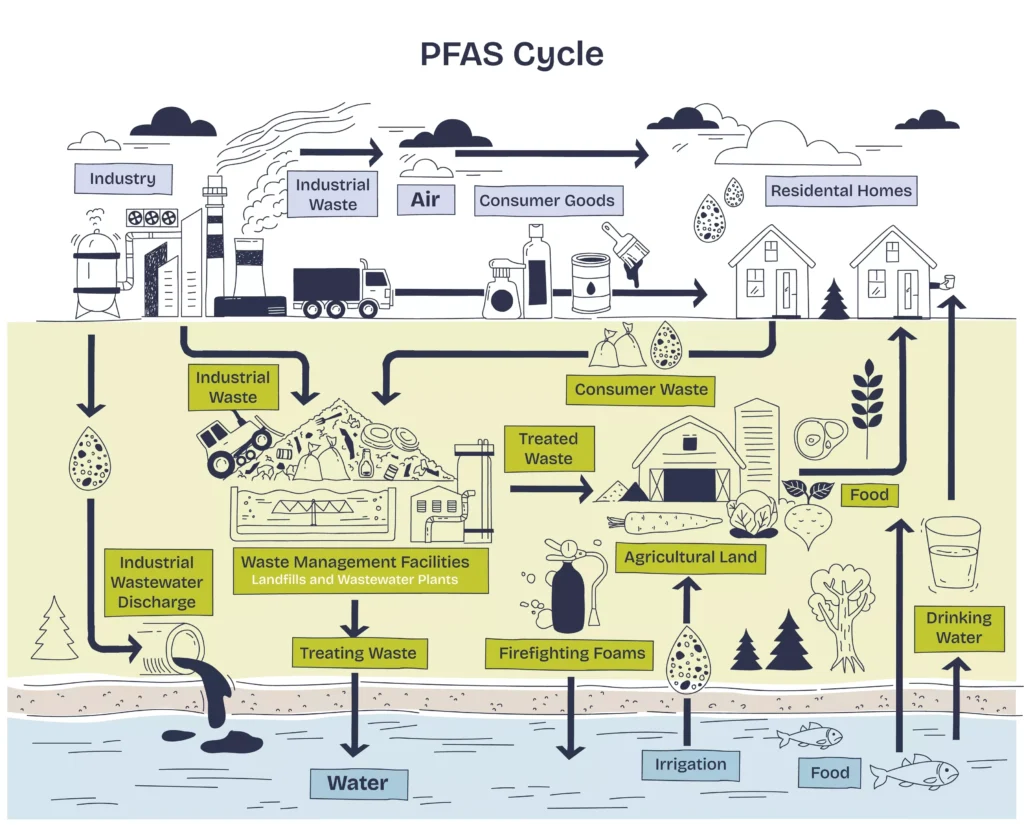
For property developers and general contractors, understanding the evolving landscape of environmental regulations is key to advancing projects seamlessly. When it comes to PFAS soil contamination, the stakes are rising, and proactive knowledge is your most powerful tool. These “forever chemicals” present a unique challenge, but with the right approach, they don’t have to be a project-killer. Instead, they can be a manageable milestone when equipped with strategic insight into their nature, regulatory momentum, and the practical implications for your development pipeline.
Understanding PFAS: The “Forever Chemicals” Explained
PFAS, or per- and polyfluoroalkyl substances, are a group of man-made chemicals that have been used extensively in various industrial and consumer products since the 1940s. Their widespread application stems from their unique properties: they resist heat, oil, stains, and water. This made them ideal for everything from non-stick cookware and water-repellent fabrics to firefighting foams (AFFF), industrial lubricants, and food packaging.
The challenge with PFAS lies in their incredibly strong carbon-fluorine bonds, which make them extremely persistent in the environment and in the human body – hence the moniker “forever chemicals.” They don’t break down easily, leading to their accumulation in soil, water, and even the air. While thousands of different PFAS compounds exist, two of the most studied and regulated are PFOA (perfluorooctanoic acid) and PFOS (perfluorooctane sulfonic acid). The concern over PFAS stems from growing scientific evidence linking exposure to potential health effects, driving a rapid acceleration in regulatory action.
The Accelerating Regulatory Landscape for PFAS
The regulatory environment surrounding PFAS is dynamic and rapidly evolving, moving from an emerging concern to a significant focus for environmental agencies nationwide. Developers and environmental consultants must stay attuned to these shifts to unlock project potential rather than encounter unexpected hurdles.
The U.S. Environmental Protection Agency (EPA) is at the forefront of establishing comprehensive strategies. In April 2024, the EPA finalized the first-ever national drinking water standard for several PFAS compounds, including PFOA, PFOS, PFNA, PFHxS, and HFPO-DA (GenX chemicals), and established a hazard index for mixtures of others. This landmark ruling will likely drive further action regarding soil and groundwater remediation standards.
Beyond drinking water, the EPA has designated PFOA and PFOS as hazardous substances under the Comprehensive Environmental Response, Compensation, and Liability Act (CERCLA), or Superfund. This designation significantly impacts liability for responsible parties, including current property owners and operators, and can trigger remediation requirements on contaminated sites.
At the state level, action is even more varied and aggressive. Over 40 states have introduced or passed legislation addressing PFAS, ranging from establishing specific discharge limits and developing cleanup standards for soil and groundwater to banning the use of certain PFAS in products. States like Michigan, New Jersey, and Massachusetts have been particularly proactive in developing site-specific guidance and health-based criteria for PFAS in various media. This patchwork of regulations means that a nationally capable, locally grounded approach to environmental mitigation is critical for any development project, ensuring compliance regardless of location.
Building Implications: Navigating PFAS Contamination on Development Sites
For developers, PFAS soil contamination introduces several critical considerations that can impact project timelines, budgets, and long-term viability. Proactive planning is essential to transform potential obstacles into manageable milestones.
Site Assessment and Due Diligence
The first step in any development project is thorough due diligence. For sites with a history of industrial use, adjacent to potential PFAS sources (like airports or military bases that used AFFF), or with known groundwater impacts, PFAS screening should become a standard component of Phase I and Phase II Environmental Site Assessments (ESAs). Identifying potential PFAS contamination early allows for informed decision-making and avoids costly surprises down the line. Industry experts recommend consulting with environmental professionals experienced in PFAS sampling protocols and analytical methods, which differ significantly from traditional contaminant analyses.
Remediation Challenges and Strategies
If PFAS contamination is identified, remediation can be complex. Traditional “dig and haul” methods for soil can be prohibitively expensive due to the specialized disposal requirements for PFAS-laden materials. In situ treatment technologies are emerging, such as chemical oxidation, bioremediation, and adsorption, but their effectiveness can vary depending on the specific PFAS compounds and site conditions. For groundwater, pump-and-treat systems with activated carbon or ion exchange resins are common, but they require ongoing maintenance and monitoring.
The evolving nature of PFAS science means that remediation technologies are constantly advancing. Partnering with a strategic environmental mitigation expert can help identify the most cost-effective and technically sound solutions, enabling projects to move forward without unnecessary delays.
Vapor Intrusion and Indoor Air Quality
While PFAS are primarily known for soil and groundwater contamination, their volatility can also lead to vapor intrusion concerns, especially for shorter-chain PFAS compounds. This means that PFAS vapors from contaminated soil or groundwater could migrate into indoor spaces, impacting indoor air quality. For new construction, this necessitates careful consideration of vapor barriers and mitigation systems, similar to those used for VOCs or radon. Ensuring a safe and healthy indoor environment is paramount for occupant well-being and project success.
Financial and Legal Considerations
The “polluter pays” principle under CERCLA means that liability for PFAS cleanup can extend to current property owners, even if they weren’t responsible for the initial contamination. This underscores the importance of robust environmental indemnities and insurance in property transactions. Furthermore, lenders are increasingly scrutinizing sites with potential PFAS issues, making early identification and a clear mitigation strategy crucial for financing.
Navigating the complexities of PFAS soil contamination requires a strategic partner who understands not just the problem, but the pathways to resolution. By translating complex regulations into clear action plans, industry experts enable developers and contractors to unlock the full potential of their sites, creating safer spaces and advancing development possibilities across the nation.